Affiliate Marketing With No Money and No Website: 14-Day Plan
Affiliate marketing with no money is possible: you pick an offer that fits an audience you know, get a free referral link, place it in your bio, a Telegram channel, a short video or a permitted message, track your own clicks, and disclose that the link pays you. Nothing is guaranteed. Results depend on audience trust and consistency, and can be zero at first.
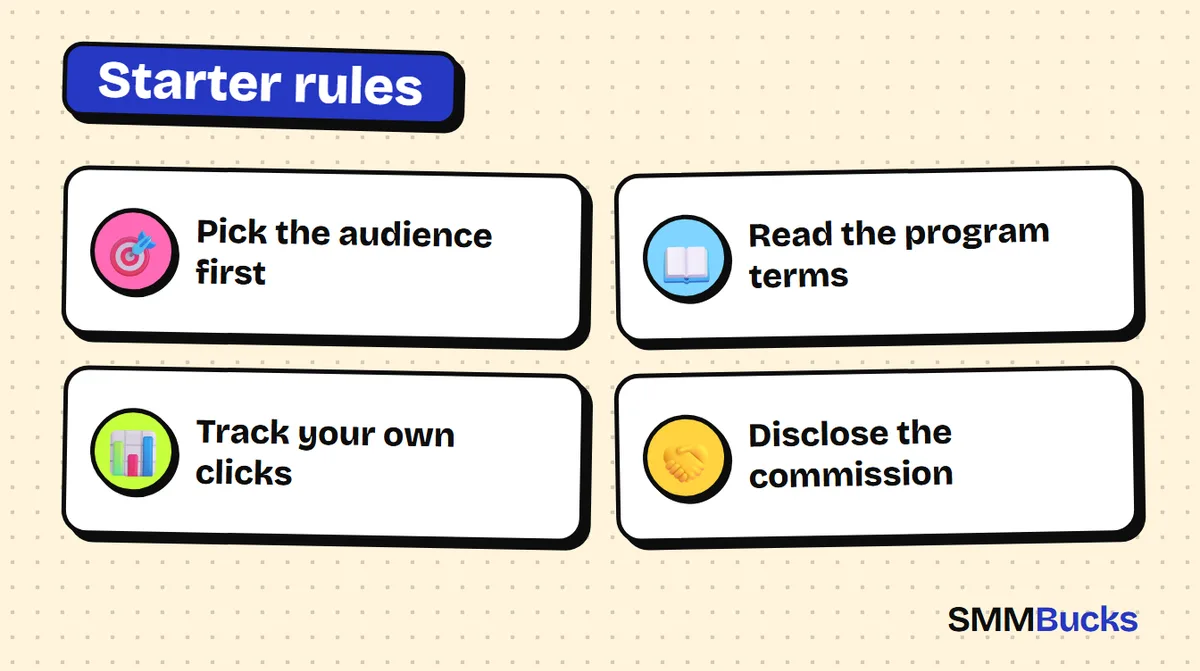
- Pick the audience first
- Read the program terms
- Track your own clicks
- Disclose the commission
The biggest obstacle for most beginners is not money. It is the belief that you need a website, a store and an ad budget before you can start. In reality, affiliate marketing with no money begins with one link and one account whose audience you understand. This guide gives you the path in order: how to pick an offer, where to place a link without a website, how to track clicks, how to judge any program, and a 14-day plan. No income promises, because results vary and can be zero.
What is affiliate marketing, and can I start affiliate marketing with no money?
Affiliate marketing means earning a percentage or a fixed fee for each customer or sale that arrives through your personal link. You do not make, ship or support the product. Because joining most programs is free, affiliate marketing with no money is possible in principle.
But "no money" does not mean "no cost". You pay with your time and with your reputation every time you recommend something. Some programs also require approval, so read each program's terms yourself.
Warning: Nobody can guarantee income from this model. Without an audience that trusts you, weeks can pass without a single useful click.
How to start affiliate marketing with no money step by step: five steps
The short answer to how to start affiliate marketing with no money step by step: choose an audience, then an offer that serves it, get your link, place it where people will see it, and track and disclose.
- Define your audience: who follows you, or who can you realistically reach? Write one sentence: "I help [these people] with [this problem]".
- Pick the offer type: what does your audience actually complain about? Match the offer to that.
- Join and get your link: start with one program, not ten. One you understand beats ten whose terms you never read.
- Place the link where people can reach it without you owning a website.
- Track and disclose: count your clicks, and tell your audience the link earns you a commission.
Do you need a website for affiliate marketing? Where to put your links
No, a website is not required. Affiliate marketing without a website relies on platforms that give you ready-made space: a bio link, a channel, a short video or a direct conversation. Before placing a link anywhere, check that platform's rules on external and affiliate links, since some restrict them or require disclosure.
Your bio link
Most social platforms allow a profile link, but eligibility changes, so check your account settings today. Keep it to one clear link, and say in the first line of your bio what visitors will find.
A Telegram channel
Post a useful tip every day or two, and mention your link only when it serves the topic. More ideas are in our guide to affiliate marketing on Telegram and TikTok.
Short videos and replies
Film thirty seconds that solve one small problem, then point to your bio link once. If someone asks in the comments about something the offer solves, answer first, then share the link. Never mass-message strangers; it may break platform rules.
What does a referral program look like? An example with SMMBucks
A referral program is a type of affiliate marketing: you get a personal link, and anyone who signs up through it and uses the service is counted as yours. As a practical example, SMMBucks runs a referral program that pays a commission on every deposit made by the users you refer.
- You need no capital, you just share your link.
- The commission applies to the deposits of the people you refer, not to one single event.
- The Earn with SMMBucks page currently shows a 10% rate. Rates can change, so check the page before relying on any figure.
- The page tags the program as a fit for influencers and coaches. Full details are on the affiliates page.
This offer suits a specific audience: people who care about growing social media accounts. If yours does not, it is the wrong fit however attractive the commission. To understand it first, see the services list and what an SMM panel is.
Tip: Never promote something you do not understand. Read the whole offer page and try signing up yourself.
How do you judge an affiliate program before joining?
Ask five questions before you put any program's link anywhere. If the program page gives no clear answer to one, treat that as a warning sign rather than assuming the best.
- Attribution window (cookie): if someone clicks today and signs up next week, are you credited? Look for it in the terms.
- Payment terms: how is commission calculated and approved? Read the official text, not a marketer's video.
- Product fit: does it solve a real problem for your audience?
- Promotion rules: some programs forbid paid ads on their brand name, or unsolicited messages.
- Transparency: is there a dashboard showing clicks and sign-ups?
For SMMBucks's referral offer, check the official page to see what is actually published, and do not assume what is not stated. A high commission alone is never a reason to join.
How do you track clicks and results yourself?
You do not need a paid tool. Two sources are enough: the program's own dashboard if it has one, and the analytics of the platform you post on. Write the numbers down weekly in a simple file with five columns: date, placement (bio, channel, video), reach, clicks, and sign-ups or sales.
Then use these formulas with your own numbers:
- Click rate = clicks ÷ reach.
- Conversion rate = sign-ups ÷ clicks.
- Expected earnings = sign-ups × average spend per user × commission rate.
Hypothetical example (invented numbers for illustration only, not industry benchmarks): imagine a video reaches 2,000 people, 20 click, 2 sign up, and each deposits $10 at a 10% commission. The result: 2 × 10 × 0.10 = $2. The point is to see the formula, not to expect that outcome. Use your own numbers after two weeks of posting.
Why should you disclose that your link earns a commission?
Because your audience deserves to know, and because many platforms and programs expect it. Disclosure strengthens your recommendation: people respect "this is a referral link I benefit from" far more than a hidden link that gets discovered.
- Write in the first line or description: "This link is mine and I may earn a commission if you sign up through it".
- Never claim an experience you did not have.
- Read the platform's and program's rules on affiliate disclosure, because rules change.
- Check your local laws on advertising and referrals. This guide is not legal advice.
Example wording: "I use this tool myself. If you sign up through my link I earn a small commission and you do not pay more. If it does not suit you, ignore it."
What is a 14-day plan for affiliate marketing for beginners?
Affiliate marketing for beginners works better in small daily steps than in one burst followed by silence. Adjust this plan to your schedule.
- Day 1: write your audience sentence and pick the offer type.
- Day 2: read three program pages using the five questions above.
- Day 3: join one program and try the product yourself.
- Day 4: set up your bio link, disclosure line and tracking file.
- Days 5 to 7: publish three useful posts, some without a link, to see what draws attention.
- Day 8: start a small Telegram channel if it suits your audience.
- Days 9 to 11: publish two short videos solving one problem, mentioning the link once.
- Days 12 and 13: answer every question honestly, then review your tracking file: which placement brought clicks?
- Day 14: decide whether to repeat what worked or change the audience or offer.
The two weeks may end with no commission. That is not failure; you now have real data to decide with. For a lighter plan, read the three-hour weekly referral system.
What beginner mistakes ruin affiliate marketing?
Most failures come from repeated habits, not bad luck.
- Promoting everything: ten links on one page kills trust.
- Choosing by commission only, instead of asking whether your audience needs it.
- Hiding that the link is affiliate: it harms your reputation and may break rules.
- Mass-messaging strangers: it can get accounts restricted.
- Income promises: "you will earn" is something you cannot deliver.
- Skipping tracking, so you cannot tell what works.
- Quitting after one week: building needs consistency.
To compare other routes, read our beginner's guide to making money online.
When is this model not right for you?
Affiliate marketing is not for everyone, and finding that out early saves months.
- You need steady income this month. This model is slow and uncertain.
- You have no audience and no plan to build one. Without reach there are no clicks.
- You are uncomfortable recommending products by name or disclosing a commission.
Another route may suit you better, such as selling a skill, a structured side job, or building your account first. To own a brand after testing the market, there is the child panel, which needs a separate subscription and whose results vary from person to person.
Frequently asked questions
Can I start affiliate marketing with no money?
Yes. Many referral programs are free to join, and you only need your link and an account to share it from. But you pay with time and reputation, and some programs require approval first. Nothing is guaranteed: results follow your audience and consistency, and may be zero at first.
How do I start affiliate marketing without a website?
Choose an audience and a matching offer, get a referral link, then place it in your bio, a Telegram channel, a short video or a conversation where it is allowed. Check each platform's rules on affiliate links, track clicks in a simple file, and tell your audience the link earns you a commission.
Do you need a website for affiliate marketing?
No. A website helps some people, but it is not required. You can share a referral link through a bio link, a channel, short videos or direct replies. You do need some audience to reach and honest disclosure. Platform rules on affiliate links can change, so check them before posting.
How much can I earn from affiliate marketing for beginners?
Nobody can give an honest number, because it depends on your audience size, their trust and the offer's fit. Calculate from your own data instead: clicks × sign-up rate × average spend × commission rate. Start with modest expectations, and today write one sentence describing your audience.
What is a referral program and how is it different?
A referral program gives you a personal link, and you earn a commission when people sign up through it and use the service. With SMMBucks, commission is calculated on deposits by the users you refer, and the page currently shows 10%, which may change. Check the Earn with SMMBucks page for the current terms.
How do I know an affiliate program is worth joining?
Read its official page for the attribution window, how commission is calculated, promotion rules and whether a dashboard shows your clicks. Then ask whether your audience needs the product and whether you would use it yourself. If a question has no clear answer, do not assume the best.
Do I have to disclose that my link is an affiliate link?
It is always best to, and many platforms and programs expect it. Put a line in the description or first sentence saying the link is yours and may earn you a commission. Check platform rules and your local laws; this guide is not legal advice.
Try the referral program yourself
Open the Earn with SMMBucks page to see the current offer and its terms exactly as published, then decide whether it fits your audience.
See the program