Buy Twitter Likes and Reposts: SMM Panel vs Engagement Groups
If you want to buy Twitter likes, an SMM panel gives you a priced order that starts automatically after payment, while engagement groups trade likes with strangers and your time. X's rules prohibit both coordinated engagement swaps and paid inflation of metrics. Your own audience is the lowest-risk option. No service guarantees results, so test with a tiny order and judge by your analytics.
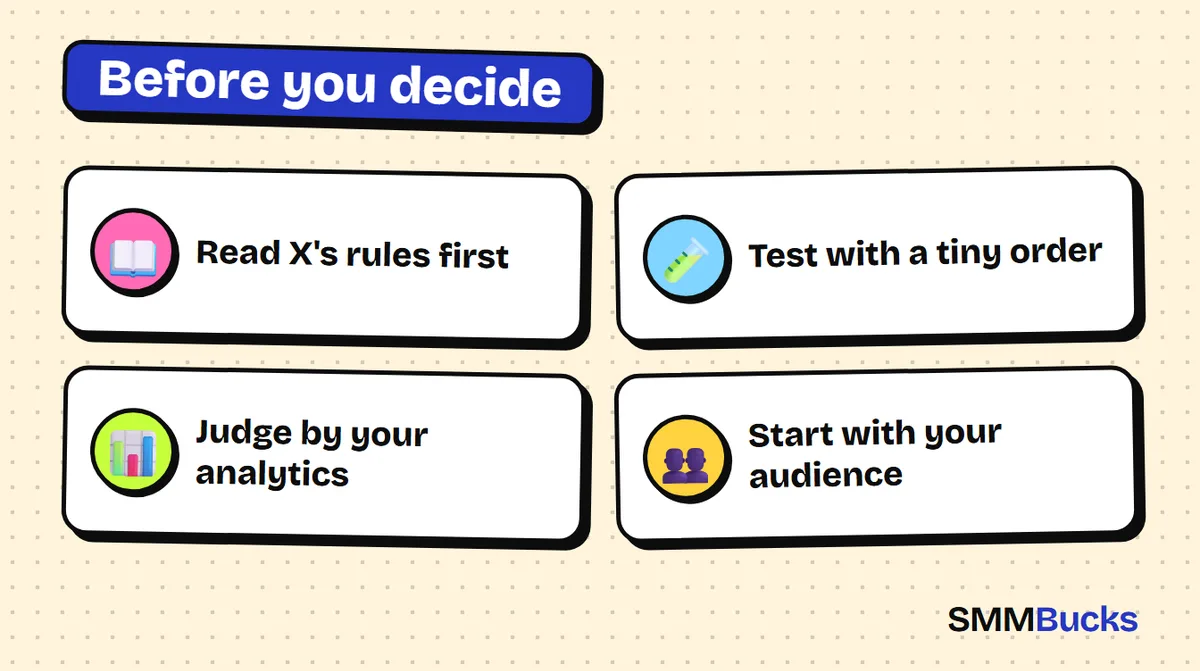
- Read X's rules first
- Test with a tiny order
- Judge by your analytics
- Start with your audience
You post a tweet you are proud of, and under it sit three lonely likes. Now two shortcuts look tempting: buy Twitter likes from an SMM panel, or join an engagement group where members swap likes and reposts. Both promise a bigger number, but they differ a lot in cost, control and risk. This guide compares them with a third, free option, then gives you a simple decision rule and a cheap two-week test.
What are your three options to get more likes on X?
To get more likes on Twitter (now X), you have three routes: order a service from an SMM panel, join engagement groups, or ask the audience you already have.
- SMM panel: a site where you add balance in advance, then order likes or reposts for a public tweet link. The order starts automatically after payment and needs no password, only a public link.
- Engagement groups: chat groups (often on Telegram or WhatsApp) where members agree to like and repost each other's tweets. You pay with time, not money.
- Your own audience: friends, customers and followers you ask directly to engage.
One naming note: retweets are now called reposts on X, and a quote lets you add your own comment before sharing. That is why people search both "buy Twitter likes and retweets" and "buy Twitter likes and reposts". It is the same thing.
Can you buy likes on Twitter (X) from an SMM panel, and how does it work?
Yes, panels sell likes and reposts as a service, and that is exactly what people mean when they search to buy X likes. You top up your balance, pick a likes or reposts service, paste a public tweet link, choose a quantity, and the order starts automatically after payment.
At SMMBucks, X (Twitter) likes and reposts start from $0.24 per 1000. Prices are shown in USD and can change, so check the X (Twitter) services page before ordering.
Before you pay, check these three things:
- The service description: does it mention refill, and what are the limits?
- That your account is public, because it must be public when the order starts.
You follow progress in your order history. If an order is only partially delivered, the undelivered part is refunded to your balance. That makes the cost clear in a way the other options do not.
What are engagement groups on X and how do they actually work?
Engagement groups on X are communities whose members agree to like, repost and often reply to each other's tweets. You drop your tweet link in the group and are expected to engage with other members' links in return. In short, you pay with your time instead of money.
They look free, but they carry hidden costs:
- Daily time: to receive a few dozen interactions you usually have to give a few dozen.
- Uninterested audience: members engage because they must, not because your content matters to them, so it rarely turns into follows or sales.
We cover the same mechanics for another platform in our guide to Instagram engagement groups and pods. The logic carries over to X.
What do X's rules say about buying likes and swapping engagement?
X's rules push against artificial engagement. Its Platform manipulation and spam policy describes inauthentic engagement meant to make accounts or content look more popular than they are, and its Authenticity page refers to coordinating engagement exchanges such as likes and reposts, or paying to inflate metrics.
That matters because it puts both the paid route (a panel) and the swap route (a group) in territory the platform warns about. Only the third option, your own audience, sits clearly outside it. So:
- Read the official X Help Center pages yourself before deciding. Wording changes, and the pages we checked may be updated.
- No panel, group or provider can guarantee that your account will not be affected by platform enforcement.
- Consequences are not limited to suspension. Platforms can also limit how widely content is shown, so weigh that too.
Warning: if your X account is your income or your brand, count this risk before testing anything that adds engagement not coming from your real audience. See is buying followers safe? for the wider picture.
How do a panel, groups and your audience compare on six criteria?
A fair comparison needs fixed criteria. Here are the three options, described in words rather than invented statistics.
Cost and control
- Panel: a known price per 1000, and you control quantity and the tweet link.
- Groups: no money, but open-ended time, and you control neither who engages nor when.
- Your audience: free, and you control only how well you ask.
Audience fit and measurability
- Panel: raises the visible number, but nobody is guaranteed to care about your content.
- Groups: usually human accounts, but uninterested in your niche.
- Your audience: the only option whose engagement can turn into replies, sales or follows, and it is easy to measure in your own analytics.
Speed, effort and risk
A panel is the fastest and lowest effort, but carries policy risk. Groups cost the most effort and carry similar risk. Your audience is slowest and needs patience, but has the lowest risk. Treat every outcome as uncertain.
How much does it cost to buy Twitter likes? A hypothetical example
The cost to buy Twitter likes from a panel is the price per 1000, divided by 1000 and multiplied by your quantity. At $0.24 per 1000, an order of 500 likes costs about $0.12.
Hypothetical example (every assumption is written out and says nothing about your account):
- You post 10 tweets per week.
- You order 300 likes for each.
- The assumed service price is $0.24 per 1000.
Formula: (quantity ÷ 1000) × price × number of tweets. So (300 ÷ 1000) × 0.24 × 10 = $0.72 per week, roughly 2.70 SAR (approx.).
Now compare a group: if you spend 30 minutes a day engaging with strangers, what is your hour worth? Answer that before calling a group "free". To learn how to read panel prices, see our Twitter followers price and quality guide.
How do you get more likes from your own audience, without groups or buying?
Ask for one clear action inside the tweet itself, not through mass messages. People engage when they know exactly what you want and the ask is easy and useful to them.
Templates you can copy and adjust:
- Question template: "Which would you pick? Reply 1 or 2."
- Save template: "If these three points helped, repost this for a friend who needs them."
Small habits that raise real engagement:
- Post when your audience is active, checking your own account analytics.
- Answer every reply within the first hour.
- Comment usefully on tweets from people in your field, never with a generic phrase.
It is slower than any "store" that sells likes, but it builds people who actually understand you. More tactics are in our Twitter (X) growth guide.
When don't you need to buy likes or join groups at all?
You do not need either if your problem is the content or the offer, not the number. Added likes cannot fix a tweet with no idea, and they will not make anyone buy your product or follow your advice.
- If your account is new and has no clear identity, start with a steady routine such as the 30-day new account plan.
- If any policy risk to your account worries you, stick with organic growth.
- If you expect purchased likes to bring sales automatically, they will not.
Tip: before spending anything, open your analytics. How many impressions did your last 10 tweets get? If impressions are very low, reach is the problem, not likes.
Which should you choose? A simple decision rule
Short rule: start with your audience, consider a panel only if you want a priced, small test and accept the policy risk, and skip groups if your time or account reputation matters.
- Choose your audience if some people already follow and engage, or if your sales rely on trust.
- Choose an SMM panel if you want a small test with a known cost, you understand that a number is not an audience, and you have read the platform rules and decided responsibly.
- Choose an engagement group if you have no budget and no time to measure, and can live with low-quality interaction. We do not recommend it, because swapping engagement conflicts with X's stated rules.
Related reading: our X likes and reposts guide, and a comparison of Arab versus foreign followers if you target a specific region.
How can you test the options cheaply in two weeks?
Run a small, measurable test: keep content quality constant, change one factor per tweet, and record results from your own analytics.
- Days 1 to 3: post 3 tweets with no intervention. Record impressions and likes for each.
- Days 4 to 7: post 3 similar tweets and end each with a direct question for your audience.
- Days 8 to 10: if you decide to test, order a very small quantity from a panel (for example 100 likes) on a single tweet.
- Days 11 to 14: compare. Did replies, link clicks and new followers change, or only the visible number?
Mistakes to avoid:
- Testing two services on one tweet, so you cannot tell which did what.
- Ordering a large quantity suddenly on a small account.
- Judging after one day.
Always check the order in your order history, use the Refill button if the service supports it, and see the FAQ page. When you are ready, browse all services. SMMBucks lets you start with a small order.
Frequently asked questions
Is it safe to buy Twitter likes?
No service can promise full safety. X's rules prohibit inauthentic engagement and coordinated engagement exchanges, and platforms can limit visibility as well as restrict accounts. Read the official X Help Center pages, start with a very small order if you decide to test, and never base a business decision on the number alone.
What is the difference between buying likes from a panel and joining engagement groups on X?
A panel gives you a priced order that starts automatically after payment. An engagement group relies on swapping interactions with strangers, paid for in your time. A panel is easier to budget and measure, while a group costs more effort and gives you less control. Both sit in an area X's rules warn about.
How much does it cost to buy X likes at SMMBucks?
Likes and reposts for X (Twitter) at SMMBucks start from $0.24 per 1000, roughly 0.90 SAR (approx.). The site shows prices in USD and they can change. Services differ by type and description, so read each service's description, limits and refill note before ordering.
Do I need my password to buy likes?
No. A public tweet link is enough, and your account must be public when the order starts. Never give your password to any site. A provider that asks for it to add likes is putting your account at risk, so walk away.
Do purchased likes turn into followers or sales?
Usually not by themselves. A higher visible number may create a first impression, but real decisions depend on your content and your audience's trust. Judge results with your own analytics: replies, link clicks and new followers, rather than the like count alone.
What is the difference between a retweet and a quote on X?
A retweet, now called a repost, shares a tweet as it is with your followers. A quote lets you add your own comment or media before sharing. X's Help Center explains both, so check it if the interface has changed.
What happens if an order is not completed?
If only part of an order is delivered, the undelivered part is refunded to your balance. If numbers drop later and the service supports refill, use the Refill button in your order history. Check the service description to see what refill covers.
Start with a small test
Look at SMMBucks pricing for X (Twitter) services, read each service description, then test a tiny order and compare it with your own analytics.
See X services