Buy Followers vs Influencer Collaboration: A Practical Comparison
Buying followers is a cheap way to make a new account look less empty, while an influencer collaboration costs more but puts your account in front of an audience that already exists and may bring visits or sales if the fit is right. Neither is guaranteed. Measure both with your own analytics, disclose paid partnerships, and read each platform's policies first.
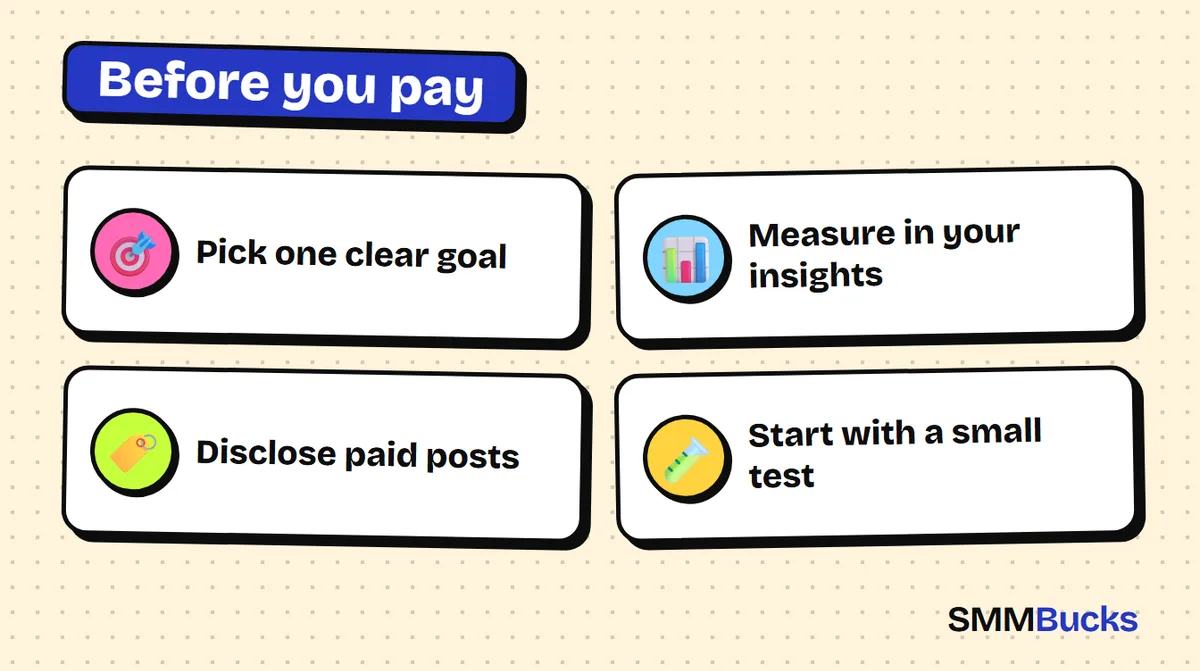
- Pick one clear goal
- Measure in your insights
- Disclose paid posts
- Start with a small test
You have $100 and a young account, and two obvious paths: pay an influencer to show your profile to their audience, or turn the same money into thousands of followers within minutes. The useful question is not which costs less, but what you want to happen after the number goes up. This guide compares influencer collaboration with buying followers on cost, speed, risk and measurement, runs a hypothetical example, and ends with a decision rule and a small test plan.
What is the difference between influencer collaboration and buying followers?
An influencer collaboration means someone with an audience introduces your account or product to it in exchange for money, a free product or a swap. Buying followers raises your visible follower count through a service, without necessarily introducing you to anyone. One buys attention, the other buys a number.
Attention may turn into visits, comments and purchases, or it may not, depending on how well the audience matches your offer. A number gives first-time visitors a more established-looking profile, but does not make anyone watch your posts. We covered the appearance side in our guide to social proof for stores.
What is influencer collaboration with brands, and which types can you choose?
The influencer collaboration meaning is simple: a creator and a brand work together on content. The common forms are a paid post, a free product in exchange for a mention, and a shout-out swap between similar accounts.
- Paid partnership: you pay an agreed fee for a defined placement (a story, a reel, a post) and carry a fixed cost whether or not it works.
- Product for exposure: no cash, but you pay for the product and shipping, with less control over what is said.
- Shout-out swap: an account of similar size promotes you and you promote them. It costs only time.
Typical influencer collaboration examples are a skincare brand sending a kit for a reel, or two coaches swapping story mentions. Before agreeing, ask for screenshots of the creator's in-app insights (recent views, audience age and country). Followers do not equal viewers.
How do the two options compare? Six criteria
Ask the same questions about each option: cost, speed, fit, risk, effort and measurement.
- Cost control: follower services are priced per 1,000 and you can start very small; SMMBucks lists Instagram follower services from $0.42 per 1000, depending on the service. An influencer quotes a flat fee that varies hugely and must be negotiated.
- Speed: orders start automatically after payment, but no completion time is promised. A collaboration needs outreach, agreement and a posting date.
- Audience fit: a well-chosen influencer wins here. Buying does not select an interested audience, even when a service lists a country.
- Risk: with buying, accounts may not engage, counts can drop, and platforms have policies on artificial engagement you should read. With a collaboration, you risk a fee that does not come back and the reputation of someone you do not control.
- Measurement: in both cases, measure from your own analytics, never from anyone's promises.
What is the real cost of an influencer collaboration versus a follower? A hypothetical example
Cost per follower is what you paid divided by followers actually added, but the number that matters is the cost per engaged follower or per visitor who buys. The example below is entirely hypothetical, and every figure is an assumption you can swap for your own.
Hypothetical example: you have $100 and a small Instagram account.
- Buying route: you order 5,000 followers at $0.42 per 1000, paying about $2.10 and keeping $97.90. That is roughly $0.0004 per follower. But if only 1% of them ever see your reels, that is 50 viewers.
- Influencer route: you pay $100 for one story. Assume it gets 3,000 views, 2% tap through to your profile (60 visits) and 10% of those follow you (6 new followers). That is about $16.70 per follower.
The formula to re-run: cost per follower = amount paid / (views x tap-through rate x follow rate). These rates are assumptions, not industry benchmarks, and your real results could be higher, lower or zero. The lesson is not that buying wins because it is cheaper; bought followers do not necessarily buy anything. Compare both routes on one metric: how many interested visitors reached me per dollar?
Influencer collaboration cost varies by audience, content type and usage rights, so get written quotes and compare them against actual views.
Which is better for your account: influencer collaboration or buying followers?
There is no permanent winner; the better choice follows your goal. Pick an influencer collaboration if you want visits and sales from a specific audience. Pick buying if you only want your profile not to look empty to people who arrive after an ad or a recommendation.
Choose influencer collaboration if:
- You have a clear offer (product, service, course) and a trackable link.
- You found a creator whose audience resembles your customer and who lets you review their insights.
Choose buying followers if:
- You have good content and organized posts, but a very low number makes visitors leave.
- Your budget cannot cover a creator, and you want a small, measurable step. You can start with a small order on the Instagram followers page and watch the effect.
- You accept that a number brings no engagement or sales by itself.
A third option is to combine them in a sensible order: tidy the profile first, then send creator traffic to it. For another comparison, see buying followers vs paid ads for your first 10K.
How do you disclose a paid partnership on Instagram and TikTok?
Major platforms expect paid or incentivized content to be clearly labelled, and each has its own tool. This applies to you as the brand and to the creator, and disclosure protects audience trust before anything else.
- Instagram: Instagram's help center (search "paid partnership instagram") says its policies require the paid partnership label when you create branded content, meaning content you were compensated for with money or something of value, including free products. It is added in the app and requires a Business or Creator account.
- TikTok: TikTok's help article on the content disclosure setting says promotional posts should use it, with one option for your own brand and another labelled paid partnership for third-party brands. Undisclosed marketing content may be ineligible for the For You feed.
- YouTube: YouTube offers a paid promotion checkbox in YouTube Studio; check the official page for current details.
Warning: Rules differ by country and platforms update them. Check local law and each platform's official policy pages, and write in the contract who handles disclosure and how.
When your own account mentions a paid collaboration, say so plainly. Never pay a creator and then ask them to hide it.
How can you test both options cheaply? A seven-step plan
Test before you commit: give each option a small slice of budget for two weeks and compare the same numbers. This plan is repeatable.
- Write one goal and record your baseline from insights: average views on your last ten posts, profile visits and link clicks.
- Create a separate link or code for each option so you know where every visit came from.
- Run one small collaboration, a single story or a swap, with a creator whose insights you reviewed, and agree an influencer collaboration contract or written brief that covers disclosure and deliverables.
- Order a very small quantity of followers from a service whose description you read carefully, such as those listed by SMMBucks, and make sure your account is public when the order starts.
- After two weeks, compare: new visits, messages, engagement on your latest post, and what happened to views.
- Repeat whichever option gave the best result per dollar, or stop both if neither delivered.
Track an order's status in your order history. If the service supports refill, you will see a Refill button there. For other questions, see the FAQ page.
What mistakes do people make when comparing the two?
The biggest mistake is judging the options by different metrics: followers for one, sales for the other. Pick the metric before you pay, and avoid these as well.
- Paying a big account without checking views.
- Ignoring audience fit: a creator whose audience lives abroad will not buy a product you ship locally.
- No tracking link, so you cannot tell which story brought a visitor.
- Buying a large amount at once before you know how it affects your account.
- Hiding the ad or asking the creator to hide it.
- Judging after one day: give each test two weeks.
- Believing any promise of guaranteed results. No one can promise 100%.
When don't you need either, and what should you do this week?
You do not need either option if you have no organized content or clear offer yet. Visitors would land on a profile that cannot serve them, so fixing the foundation comes before any spending.
If you are ready, here is a one-week plan:
- Day 1: update your bio and link, and pin three posts that explain who you are and what you offer.
- Days 2-4: record your numbers, shortlist three creators, and agree one small collaboration with a disclosure clause.
- Day 5: if you decide to buy, start with a small order following the service description, and read is buying followers safe? and giveaways vs buying followers.
- Day 7: compare your numbers and decide.
No service guarantees 100% results, and platforms have policies on artificial engagement, so read them and decide responsibly. To try the buying side yourself, browse the SMMBucks services or create an account on the sign-up page, and start small.
Frequently asked questions
Is influencer collaboration better than buying followers?
Not always. A collaboration is better when you want visits and sales from an audience resembling your customer. Buying followers only suits the goal of a more established-looking profile. Neither carries any promise of results, so test each with a small budget and compare your own analytics.
How much does an influencer collaboration cost?
There is no fixed price. Each creator sets a fee based on audience, content type and usage rights. Ask several creators for written quotes and compare them against actual views rather than follower counts. Do not rely on unsourced averages online, and ask whether the price includes reposting or edits.
How do I know if an influencer fits my account?
Ask for screenshots of their in-app insights: average views on recent posts, plus audience countries and ages, and check whether these match your customer. Read the comments and review past collaborations. Audience match matters more than follower count; a creator who refuses to share insights is a warning sign.
Do I have to disclose a paid collaboration with an influencer?
Platforms such as Instagram and TikTok provide disclosure tools for promotional content, as their official help pages describe, and laws vary by country. Agree on disclosure with the creator in writing and check platform policies and local rules before posting. The paid partnership label on Instagram is one such tool.
Does buying followers lead to sales?
Nothing promises that. A service raises the visible count, but turning visitors into customers depends on your content, your offer and genuine interest. Run a small order, then measure its effect on visits and messages in your own insights before repeating it.
Can I combine buying followers with an influencer collaboration?
Yes, as separate tests. Polish the profile first, then send creator traffic to it, and use a different link for each source. Change one variable at a time and note what you did and when, otherwise you cannot tell what caused the result.
What is the cheapest way to test both options?
Start with a free shout-out swap with an account of similar size, plus a very small follower order from a service whose description you have read, then watch the results for two weeks. This costs far less than a full campaign and shows which suits your account. Numbers differ between accounts.
Try a small order first
Read the service description, start with a small quantity, and compare the effect against your own insights before deciding what to continue.
Browse Instagram services