Instagram Engagement Pods vs SMM Panel: Which Is Safer?
Neither option is 100% safe. Instagram engagement pods cost you daily time and can look like coordinated, artificial activity. An SMM panel is faster and needs no password, but it falls under the same platform rules. Read Instagram's policy, run one small test, and judge the result by reach and saves in your own insights.
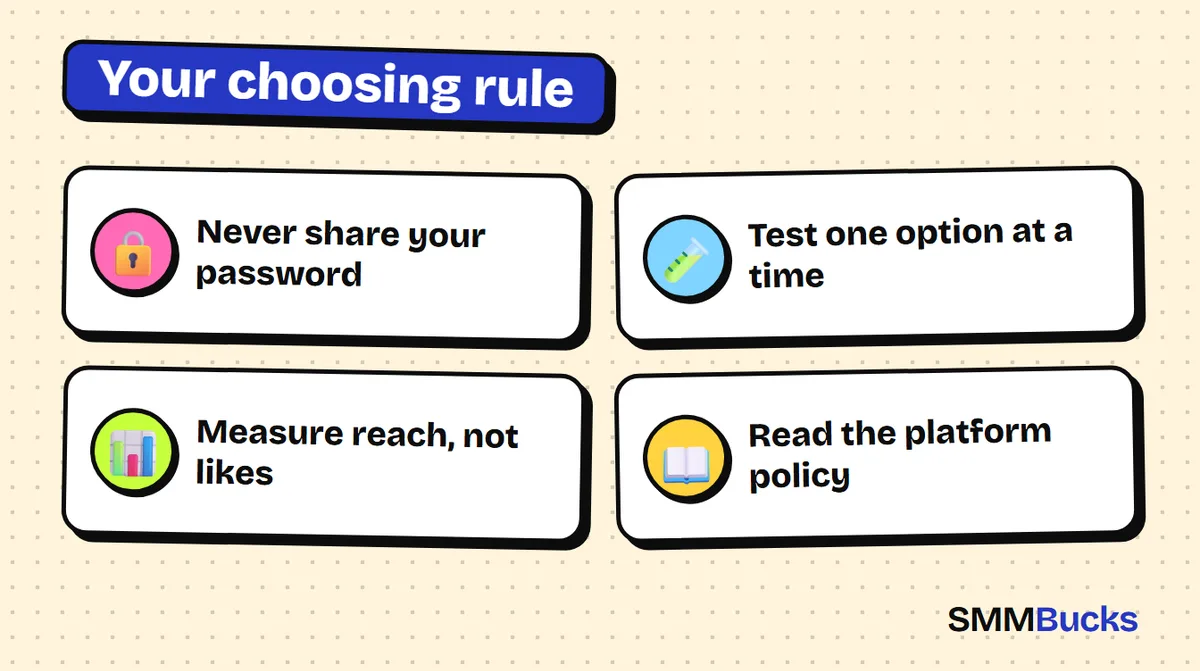
- Never share your password
- Test one option at a time
- Measure reach, not likes
- Read the platform policy
Your post was good, and it got almost no likes. One friend says to join Instagram engagement pods so the numbers start moving. Another says an SMM panel fixes it in minutes. Both promise something close, and both touch the platform's rules in different ways. This article compares the two on safety, control, effort and measurability, with no promises and no verdict decided in advance. You also get a decision rule and a small test you can run on your own account before you spend time or money.
What are Instagram engagement pods, and how do they differ from an SMM panel?
Instagram engagement pods (also called engagement groups) are groups, usually on Telegram or WhatsApp, whose members agree to like and comment on each other's posts. You drop your post link, others engage, and you return the favour. An SMM panel is a website where you order a service, such as likes or views, by entering a public link.
The real difference is who does the work. In a pod, other people trade effort with you in exchange for your time. In a panel, you pay, and the order starts automatically after payment. No password is needed, only a public link or username, and the account must be public when the order starts.
For pods alone, see our guide to engagement groups and exchange pods on Instagram. Here we focus on the comparison.
Are Instagram engagement groups safe for your account?
They cannot be called completely safe. Most of what is written about engagement groups for Instagram comes from marketing blogs, not from the platform. We did not find an official Meta page that names pods directly. What sources broadly agree on is that coordinated engagement meant to game the algorithm counts as inauthentic activity, and that its effect has faded.
These are the practical risks you meet in pods:
- Low-quality engagement: generic comments like "nice" or "love this" from accounts unrelated to your niche are a weak signal.
- Personal security risk: some groups ask you to log in through an app or hand over account details. Never do this.
Warning: Anyone who asks for your account password in exchange for likes or followers puts the whole account at risk. Instagram's Help Center explains why you should not use apps that offer likes and followers: giving them your login details gives them full access to your account.
How to check a pod before you join
- Read the pinned rules. Do they demand a fixed number of exchanges per day, or leave you free?
- Check that members come from a niche close to yours. Engagement from an uninterested audience does little.
- Look at the comments on members' posts. Are they repeated phrases, or real remarks about the post?
- Leave at once if anyone asks for a login link, an outside app, or an unclear payment.
Is using SMM panel safe compared with engagement groups?
For the safety of your login details, mostly yes: a panel that works from a link or username does not need your password. For platform rules, there is no comfortable advantage. Instagram states in its Help Center that these services are not affiliated with or endorsed by it, that it may remove likes they generate, and that repeated use may restrict parts of an account or disable it.
So the two options share one problem: neither engagement comes from your genuine audience's interest. A panel wins on one point, since you give no password and no stranger gets access to your account, but that does not remove the risk. No service, SMMBucks included, guarantees 100% that your account will be unaffected.
If you are searching for a safe smm panel instagram option, the honest answer is that safety means no password sharing and small tests, not a guarantee. For a deeper look, read is buying followers safe? and read the platform's policy yourself before any decision.
After an order, check your order history for the status and amount delivered, and compare it with the service description. On a partially delivered order, the undelivered part goes back to your balance. The FAQ page has the details.
How do the two compare on cost, speed, effort, control and measurability?
We compare them on five criteria, and each one serves a different goal. Neither option wins on all of them.
- Cost: pods cost no money but cost time. A panel costs small amounts and you control the quantity. For example, Instagram likes start from $0.03 per 1000. The price shown on the site is in USD and can change.
- Speed: pods depend on how active members are. A panel starts the order automatically after payment, but we promise no specific speed.
- Effort: pods demand daily, reciprocal engagement. A panel needs a few steps, then monitoring.
- Control: in pods you control neither who engages nor what the comments say. In a panel you choose the service type and quantity, but quality is something you read from the service description and the order history.
- Measurability: both are measurable. Compare reach, saves and shares in your own insights before and after the test.
In short: pods are cheaper in money and costlier in time, and a panel is the opposite. Neither builds an audience that cares about your content.
In both cases use a unique password and turn on two-step verification.
Which mistakes make either option riskier?
The danger often lies in how you use an option, not in the option itself. These mistakes repeat across both:
- Giving your account password to any site, app or group admin.
- Ordering a huge quantity at once for a small account, which creates a sudden jump that looks nothing like your normal growth.
- Ignoring your content: likes on a weak post do not persuade a profile visitor to follow.
- Skipping the service description and its requirements.
- Judging the result by like count alone instead of reach, saves and shares.
If your numbers drop later, read what to do when followers drop and how the Refill button works. Only some services support refill, as their descriptions state.
What does each option really cost? A hypothetical example
An honest cost adds the value of your time. This is a hypothetical example with every assumption written out, so swap in your own numbers.
Imagine a shop owner who wants likes on 20 posts per month. Assume a pod takes 15 minutes a day (7.5 hours a month), the owner values an hour at $5, and the panel charges $0.03 per 1000 likes for 200 likes per post.
- Pod cost = 7.5 hours x $5 = $37.50 of their time.
- Panel cost = 20 x (200 / 1000) x $0.03 = $0.12.
Formula: real cost = money paid + (hours spent x the value of your hour). The better question is whether the visible engagement raises your actual reach, and your insights answer that.
When should you choose engagement groups, and when an SMM panel?
The short rule: choose a pod if you have spare time and want to meet people in your niche. Choose a panel if your time is tight and you want control over quantity. If neither fits, the alternatives are real, and they matter just as much.
- Choose a pod if: you find a small group focused on your niche, its members write genuine comments, and nobody asks for your account details.
- Choose a panel if: you want a quick visual start for a new post, you accept that it is cosmetic and builds no community, and you will read the service description before ordering.
- Choose neither if: you have time for collaborations, paid ads, or steady posting. These are slower, but they reach people who care.
Tip: When do you not need either? When your account is new and has no content yet, or when your organic engagement is already healthy. Start by improving the content with these ways to raise engagement on Reels, then decide.
How can you test both options cheaply?
Test each option on its own, on a similar post, and write the results down before you decide. Here is a five-step plan:
- Record the numbers of your last five normal posts, 48 hours after posting: reach, saves, shares and comments.
- Publish a new post with no boost at all and record its numbers as your baseline.
- Publish a similar post and try one small pod for a week. Record the time you spend.
- Publish a third similar post and try a small order from our Instagram services, reading the service description and watching the order history.
- Compare the numbers: did reach and saves improve, or only likes?
If only likes improved, the result is cosmetic. If reach drops or a warning appears, stop and review the policy.
What should you do this week?
This short plan suits anyone who wants a decision based on their own numbers rather than other people's opinions:
- Day 1: read Instagram's Help Center page on apps that offer likes and followers.
- Day 2: record the numbers of your last five posts.
- Days 3 to 5: decide what to test (a pod, a panel or nothing), publish the test post and watch reach.
- Day 6: compare with your baseline.
- Day 7: put content first, and add paid growth only if it was actually useful.
If you want to test a panel, SMMBucks lists Instagram likes from $0.03 per 1000 as shown on the site, and no password is needed. Browse the services list and read every description. It is not a guarantee of any result. Also see the difference between real and fake followers to understand what you are actually buying.
Frequently asked questions
What are engagement groups on Instagram?
Engagement groups, also called pods, are groups where accounts trade likes and comments on each other's posts. They usually run on Telegram or WhatsApp. You share your post link, members engage, and you return the favour. Early engagement may help a post, but platforms can treat coordinated activity meant to game the algorithm as inauthentic, so read the policy.
Are engagement groups allowed on Instagram?
We did not find an official Meta page that names engagement groups directly. Instagram does say it may remove artificial likes and restrict accounts that repeatedly use such services. Treat pods as a grey area, check the platform's current policy yourself, and never share your password with anyone who offers likes.
Is using an SMM panel safe?
It is safer for your login, because panels like SMMBucks work from a public link and need no password. For platform rules, it carries the same risk as pods, since Instagram says artificial engagement may be removed and repeated use may restrict an account. No service guarantees account safety, so start small.
Do Instagram engagement groups work?
There is no official evidence of a specific effect on reach. Marketing sources say their effectiveness has dropped. The only reliable answer is your own: compare reach and saves before and after a small test in your insights.
Which is cheaper, pods or an SMM panel?
Pods cost no money but eat your time. A panel costs small amounts but saves time. For a fair comparison, add the money paid to the value of the hours you will spend. For example, Instagram likes at SMMBucks start from $0.03 per 1000 as shown in USD on the site, and that price can change later.
What is a better alternative to both?
No single option suits everyone. Collaborating with accounts near your niche, posting consistently, improving the first three seconds of your Reels and using the platform's own ads are all slower, but closer to an audience that cares about your content.
Should I use both at the same time?
Not at the start, because you would not know which one caused the result. Test each on a separate, similar post and record the numbers, then decide. If you continue, use small quantities and check the platform's official pages, since rules change.
Compare for yourself before you decide
Read each service description and price, and start with a small quantity if you decide to test. Prices are in USD and can change, and no service guarantees a result.
Browse services