Buy Twitter Views vs X Ads: Cost per 1,000 Views
You can buy Twitter views from an SMM panel; at SMMBucks they start from $0.02 per 1000. That raises the visible counter but guarantees no clicks, replies or followers. X ads pay to show your post to a chosen audience and report results. Work out your own cost per 1,000 views from a small test, then choose by goal.
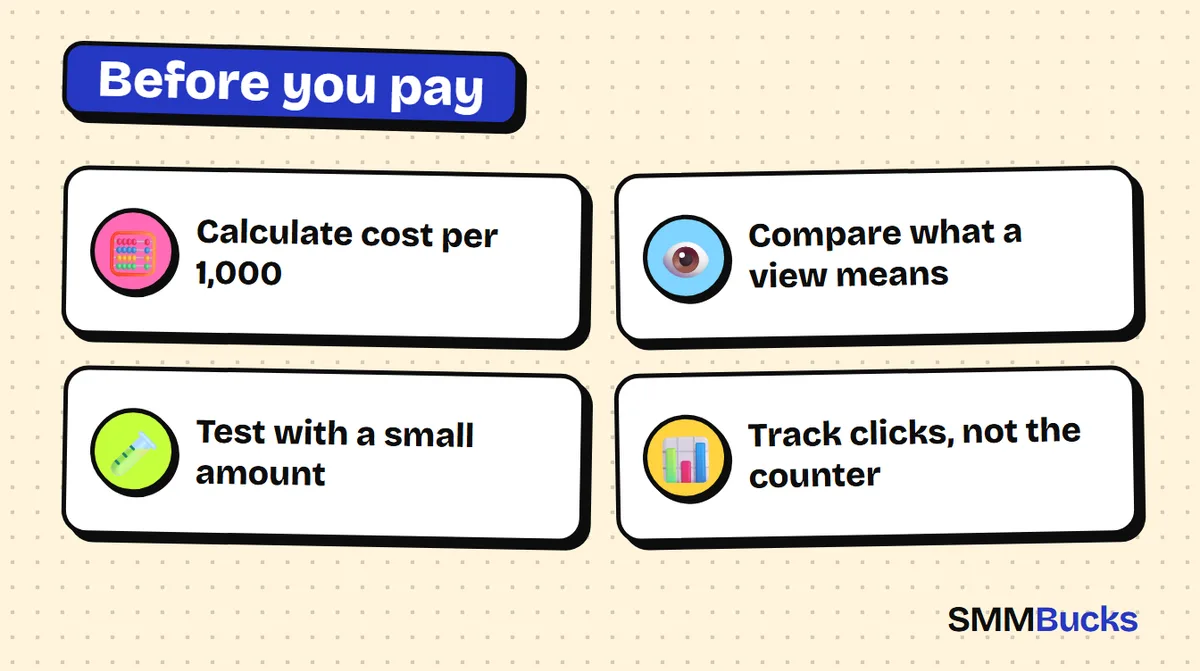
- Calculate cost per 1,000
- Compare what a view means
- Test with a small amount
- Track clicks, not the counter
You look at a post on X with a few dozen views and wonder: pay for an ad, or just buy twitter views from a cheap panel and move on? The real question isn't which is cheaper. It is what you are actually buying: a number on a counter, or people who see your post. This guide compares both, shows you how to calculate cost per 1,000 views from your own ad dashboard, and ends with a decision rule and a one-week test you can run on a small budget. No promises, just a method you can check yourself.
What is the difference between buying Twitter views and X ads?
When you buy twitter views from a service panel, you order views for a post link at a price per 1,000. With X ads, you pay the platform itself to show your post to an audience you choose, and you read the results inside its dashboard. One adjusts a number; the other buys attention from accounts the platform picks.
The word "view" also differs. X's help page on view counts says, as far as we can tell, that a view counts when a logged-in user sees your post. Video ad objectives use their own rules. Definitions change, so read the current help pages before comparing.
How do you calculate cost per 1,000 views yourself?
Cost per 1,000 views = money spent ÷ views received × 1,000. Use the same formula for an ad and for a paid service, and you compare your own numbers instead of figures from a random article.
We don't quote X ad prices: they vary with country, audience and bidding, and we have not verified them on an official page. Your own ads dashboard is the reliable source.
- Create a small campaign with a test budget you can afford to lose.
- When it ends, open the campaign report and note the amount spent and the results (views or impressions).
- Apply the formula and save the number in a note.
- Take the panel price from the service page and compare.
Hypothetical example: you spend $10 and your dashboard shows 2,500 views. Then 10 ÷ 2,500 × 1,000 = $4 per 1,000 views. These numbers are invented to show the formula, not an average. Next to $0.02 per 1,000 the gap looks huge, but the two do not buy the same thing.
What do X ads actually give you?
X ads give you exposure to an audience you target, plus reporting on what happened afterwards. You pay according to the objective you pick, which is not always the view itself.
According to X's business help pages, you can choose a video views objective, billed by their own definition of a view, or a reach objective counted per 1,000 impressions. Targeting options let you pick audiences by interest or by a custom list. Options change, so check business.x.com before you set up a campaign.
- Audience control: country, interests, or people who already engaged with you.
- Measurement: reports that guide your next decision.
- No guarantee: an ad can reach people who never react.
How to buy Twitter views from a panel, and what you get
Here is how to buy twitter views cheap and simply: choose a views service, paste the public link of one post, pick a quantity and pay. At SMMBucks, X (Twitter) views start from $0.02 per 1000 according to the catalog. The live price is always on the service page and can change.
You need only the public post link, never your password, and orders start automatically after payment. Open the Twitter services page or the full service list and read the description first, including refill and quantity limits.
Be clear about the limits. The service raises the visible count; it does not promise that a viewer will like the post, follow you or buy from you, and we don't describe any catalog views as "real". Platforms also have rules on artificial engagement, so read them and decide responsibly. See is buying followers safe?
Can you buy Twitter views, and is it better than ads per 1,000?
Yes, you can buy twitter views, and on paper the cost per 1,000 is far lower than ads. But ads buy a showing to a defined audience with measurement, so "better" depends on your goal, not on price alone. Compare them on six criteria:
- Cost control: a panel price is fixed and visible before ordering; ad prices move with bidding, though you can cap spending.
- Speed: we promise none for either. Check the service description and your campaign schedule.
- Audience fit: ads win through targeting. For a panel, rely on a country only if the description names one.
- Risk: ads live inside the platform's own tools. Panel orders touch the artificial-engagement policies, and no service guarantees anything 100%.
- Effort: an order takes minutes; a campaign needs setup and monitoring.
- Measurability: ads report what follows the view; a panel only changes a number.
Tip: want the wider picture beyond views? Read buying X followers vs ads vs organic growth.
Is it enough to buy Twitter views and likes to look credible?
If you buy twitter views and likes, a post may look busier at first glance, but numbers alone rarely build trust. Readers check replies, the profile and the content before they are convinced.
For likes and reposts in detail, read likes and retweets: panel vs engagement groups.
And if what you want is genuine reactions, an ad, a strong post or a collaboration with a fitting account is closer to that goal. That counts in the alternatives' favor.
When should you choose a panel and when should you choose ads?
Choose ads when you want a measurable result such as visits, messages or sales. Choose a panel when you only want to lift the visible number on one post with a small budget and you understand its limits.
- Choose ads if you have a landing page or a clear offer, you want a specific audience, and you accept a higher budget in exchange for measurement.
- Choose a panel if you are testing a single post, you accept that it only changes the counter, and you have read the platform's rules.
- Choose both in separate experiments on separate posts.
- Choose neither if you have no good content yet and no goal you can measure.
When you don't need this at all: if your account is new, spend your time on content first. And if you already grow at a pace you like, spend nothing.
Hypothetical example: how does the verdict change with your goal?
The verdict changes with the goal, not the price. These numbers are invented, not benchmarks.
Case one: you sell an e-book and want clicks to the checkout page. Suppose a small ad campaign brings 40 clicks. Your question is cost per click: money spent ÷ number of clicks. A views service cannot give you that number at all, because its target is the counter, not the click.
Case two: you posted good news and don't want it to look empty. A small panel order may be an understandable choice if you accept it adds no buyers and read the platform policy first. For instance, 5,000 views at $0.02 per 1,000 is $0.10 on paper, an illustration only; the live price is on the SMMBucks service page.
Case three: you want an audience that returns every week. Neither tool is enough alone; returning visitors come from the value of your content.
How can you test both options on a small budget in one week?
Test each option on a different post with a small budget, record everything on one sheet, then decide. Here is a simple seven-day plan:
- Day 1: write your goal in one sentence (I want visits to a link, or I want one post to look active).
- Day 2: publish two similar posts and note their views before spending.
- Day 3: spend a small amount you can afford to lose on an ad for one post, and a small amount on a panel order for the other.
- Day 7: apply the cost formula, and compare the actions you got (clicks, replies, followers), not only the counters.
No difference in actions between the two posts? Then the money went to a number only, a cheap lesson on a small budget.
What mistakes should you avoid when comparing, and what is the checklist?
The biggest mistake is comparing two prices that do not buy the same thing. These are the errors that show up most often in this particular comparison:
- Comparing a panel's price per view with an ad's price per view without checking what "view" means in each.
- Treating a rising counter as success while clicks, replies and followers stay flat.
- Ordering a large quantity first. Start small.
Before you pay for either option, run through this checklist:
- Did you write your goal in one sentence?
- Did you set a maximum budget you can afford to lose?
- Did you read the service description or the ad objective page?
- Will you compare actions (clicks, replies, followers), not just the counter?
- Did you read the platform's policy on artificial engagement?
Also see the Twitter (X) views guide, growing followers with ads vs buying and what an SMM panel is. For order basics, the SMMBucks FAQ page helps.
Frequently asked questions
Is it cheaper to buy Twitter views than to run X ads?
On paper, yes: at SMMBucks, X views start from $0.02 per 1000 according to the catalog. But an ad buys a showing to a chosen audience with reporting, while a panel service only changes the counter, so comparing price alone is misleading. Work out your own cost per 1,000 from your ads dashboard, then compare it with the service page price.
How much do X ads cost per 1,000 views?
There is no fixed figure we can give you, because cost depends on the objective, audience and bidding. The reliable way is to run a small campaign and calculate: money spent ÷ views × 1,000. That gives you your own number. Also check X's business help pages to see how your chosen objective defines a view.
Does buying Twitter views mean actual viewers watched my post?
You can't assume that, and we don't describe catalog views as real. A views service raises the visible counter on your post link, nothing more. To see actual audience response, look at clicks, replies and new followers in your account analytics rather than at the view count alone, and read the service description and your order history.
Is it safe to buy Twitter views and likes?
No service can promise 100% safety, and platforms have policies on artificial engagement. Read X's rules and decide responsibly, starting with a small quantity on a test post. Never share your password: SMMBucks orders need only a public post link or username.
What is the difference between views and impressions on X?
According to X's help page on view counts, a view is counted when a logged-in user sees your post. In ads, definitions depend on the objective: a video views objective bills by its own rules, while a reach objective is counted per 1,000 impressions. Read the page for the objective you choose before comparing any prices.
Do I need my password to buy views on X?
No. You only need the link to a public post. The account must be public when the order starts, and orders begin automatically after payment. Track the status in your order history and read the service description before buying.
Should I try ads or a panel first on a small budget?
Test each on a different post with an amount you can afford to lose, then compare actions (clicks, replies, new followers), not just the counter. If your goal is sales or visits, start with ads because they let you measure the result.
Start with a small test order
Read the service description and current price at SMMBucks, place one small test order on a single post, then compare it with a small ad campaign using the same formula.
See Twitter services