How to Create Own SMM Panel: Is a Child Panel Worth It?
A child panel is a website under your own name that fills your customers' orders through a bigger provider panel. It suits people with repeat customers and the energy to handle support, pricing and marketing every day. Beginners usually do better selling manually or through an API first. No profit is guaranteed, so work out your break-even point and read the provider's terms and platform policies before committing.
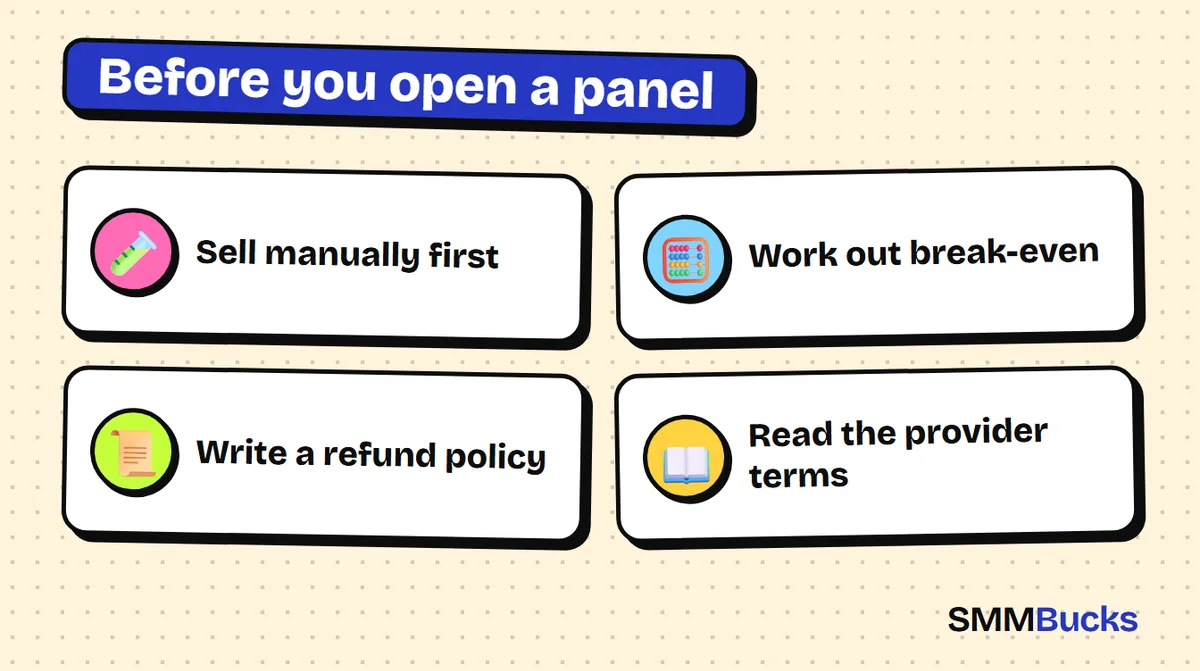
- Sell manually first
- Work out break-even
- Write a refund policy
- Read the provider terms
Plenty of people sell social media services from a personal account and private messages, then hit the same question: why don't I have a site under my own name? That is the moment many start searching how to create own SMM panel. It is not a shortcut to riches. It is a small business with real daily work. In this guide you get a one-line definition of a child panel, a comparison of three ways to sell, a sample margin, a 30-day plan, and an honest answer to when you don't need this step.
What is a child panel, and what does it mean to create own SMM panel?
A child panel is an SMM panel with a storefront under your own name that relies on a larger provider, called the parent panel, to fill the orders. Your customers sign up with you and order from you. You handle pricing and customers while the provider handles delivery.
That is the general definition used in the market. Terms and price differ between providers, so read the child panel page at SMMBucks yourself before deciding. New to the terminology? Start with what is an SMM panel.
What are the three ways to sell social media services?
There are three common routes: selling manually, connecting through an API, or owning a panel under your name. They differ in technical workload, how visible your name is to the customer, and how big a commitment you take on.
- Manual selling: a customer messages you, then you log in to a ready-made panel and place the order. No website, no coding, but you are the "button": the business stops when you sleep or travel.
- API connection: if you have a website, bot or store, you connect it to an API so orders arrive automatically. You need someone who can code. The SMM panel API guide explains it in detail.
- Child panel: a full site with your name and logo, customer sign-up, a services page, a balance and an order history. It is the most visible route and carries the most responsibility.
On the third route the customer deals with your brand, so any delay or mistake is blamed on you, not on the provider behind the scenes. Judge this route by how ready you are for that visibility, not by how easy the setup looks.
Which route fits you: manual, API or your own panel?
Choose by your current order volume, not your ambition. If you sell to a handful of people, manual selling is enough. If you run a store or a bot, an API fits best. Your own panel suits someone with a steady audience and repeat orders.
Imagine Sara sells to five friends each month: manual is plenty. Imagine Ahmed owns a store and wants the service inside his checkout: an API fits. Imagine Layla runs an educational channel whose audience keeps asking about services: a panel under her name starts to make sense.
For the wider picture, read how to start an SMM panel reseller business.
What is the real work behind a business when you start own SMM panel?
The real work is mostly not technical. It is customer service, pricing, stuck orders, marketing and trust. The panel executes, but your reputation is built on what happens when a customer asks, "Where is my order?"
- Answering customers: expect questions about orders that have not started, wrong links or private accounts. Keep ready answers for the common ones.
- Pricing: cover your cost with a margin and recheck whenever the provider's prices change.
- Refunds and re-delivery: write a clear policy. Reading each service description before you sell it protects you from promising what you cannot deliver.
- Marketing and trust: a site does not bring customers by itself, and a new customer is paying a site they have never heard of. Clear terms and honest descriptions are your real capital.
A ready reply for an order that has not started: "Hi, I checked your order. Please confirm the account is public and the link is correct, then send me the order number. If the service supports refill, you will find a Refill button in your order history."
How to make money with SMM panel: a hypothetical margin example
Profit is the gap between what you pay and what you charge, minus side costs and your time. The example below is entirely hypothetical. Its numbers are not SMMBucks prices and not a promise of income.
Imagine a service that costs you $1.00 per 1,000 units and that you sell for $1.50. If your site sold 20,000 units in a month, your cost would be $20 and your revenue $30, a gap of $10. Subtract payment fees and any tools or ads, and see what remains.
The lesson: a small margin needs high volume, and high volume needs customers and marketing. Plan around a reasonably bad month, not the best one you can imagine.
Tip: before opening a panel, write a simple sheet: fixed monthly cost, cost per order, and the minimum orders needed to break even. If that number looks far away, start manually.
How do you price your services without losing money?
Price each service upward from its real cost, not downward from competitors. Start with your cost, add a fixed margin you decide on, then compare with the market. If the market price is below your cost plus margin, do not list that service.
- Pick one margin per category instead of guessing for each service.
- Review prices weekly at the start, because provider cost can change.
- Never list a service you have not tested yourself.
The cheapest price is not an advantage alone. Customers return to whoever answers fast and explains clearly what happens after payment.
How do you check a service yourself before you sell it?
Check it with a small test: order a small quantity on an account you own, watch the order history, read the full service description, and compare what happened with what was written. The description is your real reference, not the service name.
- Read the description: does it mention refill? Is there country targeting?
- Make sure the account is public when the order starts. Orders begin automatically after payment and need no password, only a public link or username.
- Watch the order status until it completes, and try the Refill button if the service supports it.
- Write down what you learned so your own descriptions are honest.
If part of an order is not delivered, the amount for the undelivered part returns to the balance. Put that in your policy.
How to create smm panel website plans: a 30-day launch path
A 30-day plan validates demand before you build anything, then moves to preparation, a quiet launch and a review. Setting up the site is technically simple, but the order of the weeks stops you from rushing.
- Week 1, test demand: sell manually to at least five people and record what they ask.
- Week 2, prepare: read the child panel page and its terms, choose a brand name and logo, and write your refund policy and FAQ.
- Week 3, price and test: choose only ten services, set prices, and place small test orders yourself.
- Week 4, launch quietly: open the site to your first circle, collect feedback, and fix what breaks before wide marketing.
Pre-launch checklist
- You read the provider's terms and know what you are responsible for.
- Your refund policy is written.
- You tested every listed service with a small order.
- You calculated your break-even point.
- You have one channel that brings in customers.
What mistakes do new panel owners make?
The most common mistakes are listing many untested services, pricing without math, and promising what you cannot control. Each one costs customer trust, which is hardest to win back.
- Listing hundreds of services when you have tested none.
- Promising results, speed or stability, when nobody can guarantee 100%.
- Pricing below the market, then discovering you sell at a loss.
- Ignoring one angry customer, who then tells ten others.
- Ignoring platform policies on artificial engagement. Read each platform's rules and decide responsibly.
To judge a provider before you depend on one, see the guide to choosing the best SMM server.
Can you create smm panel free, and when don't you need your own panel?
Searches like "create smm panel free" are common, but a business with real customers has costs: your time, a provider subscription, payment fees and marketing. Treat free offers with caution and read the terms. You may also not need a panel of your own at all.
Skip it if you only buy for your own account, have no customers yet, or are not ready to answer people every day. A normal account through sign-up, or manual selling, is enough then.
- You want fast profit with no work.
- Your budget cannot take a single trial loss.
- You don't want to handle complaints or refund requests.
Services never replace good content and do not guarantee a particular result.
What should you do this week before you decide?
One week is enough to learn whether you should start own SMM panel or keep selling manually for now. Decide with data, not excitement.
- Browse the services page and note which platforms your audience asks for.
- Talk to five people who might buy and ask about needs and budget.
- Read the child panel page and write down your questions about terms.
- Calculate your break-even point with your own numbers.
- Decide: stay manual, connect an API, or request your own panel.
Questions about orders or refunds are answered on the FAQ page. Whichever provider you consider, compare it honestly; there is no single best SMM child panel for everyone, only the one whose written terms fit your business.
Frequently asked questions
What is a child panel in SMM?
It is an SMM panel with a site under your own name that fills your customers' orders through a parent panel at a provider. You set prices and deal with customers; the provider delivers. Terms differ between providers, so read each provider's page before deciding.
Can I get a child panel from SMMBucks?
Yes, SMMBucks lists a child panel that you can order, with details on its child panel page. Read what is written there yourself and do not assume features or prices that are not published.
What is the difference between an API and a child panel?
An API connects your own website, bot or store to the panel so orders flow automatically, without a full panel. A child panel is a complete site under your name, with sign-up, balance and order history. The API is lighter technically; a child panel is closer to an independent brand.
Do I need coding skills to create own SMM panel?
Not necessarily. The technical part is usually handled by the provider, but confirm this on the provider's page. You do need non-technical skills: answering customers, pricing and marketing. Ask yourself whether you are ready for that daily work.
How to make money with SMM panel?
There is no guaranteed figure. Profit is the difference between what you pay for a service and what you charge, minus fees, marketing and your time. Calculate your break-even point with your own numbers and avoid planning around the best case.
Is it better to start manually and move to my own panel later?
Usually yes. Manual selling shows you what people ask for without a big commitment. Once you have repeat orders and a steady audience, you can consider a panel under your name.
Does selling these services break platform policies?
Platforms have policies on artificial engagement, and they can differ and change. Read each platform's official terms yourself, be transparent with customers, and avoid promising absolute safety. No service guarantees 100% results.
Before you own your panel
Look at the child panel details at SMMBucks and read the terms yourself, then decide what fits the size of your business.
See child panel details