How to Start SMM Panel Business: A Practical Guide From Zero
You can start reselling social media services in three ways: manual orders from your own account, an API connected to your site or bot, or your own child panel. Profit is the gap between your cost and your selling price after fees. You need a clear order routine, honest expectations and no income promises, because results are never guaranteed.
Want to try one? SMMBucks SMM panel lists every service with prices, or browse the full services list.
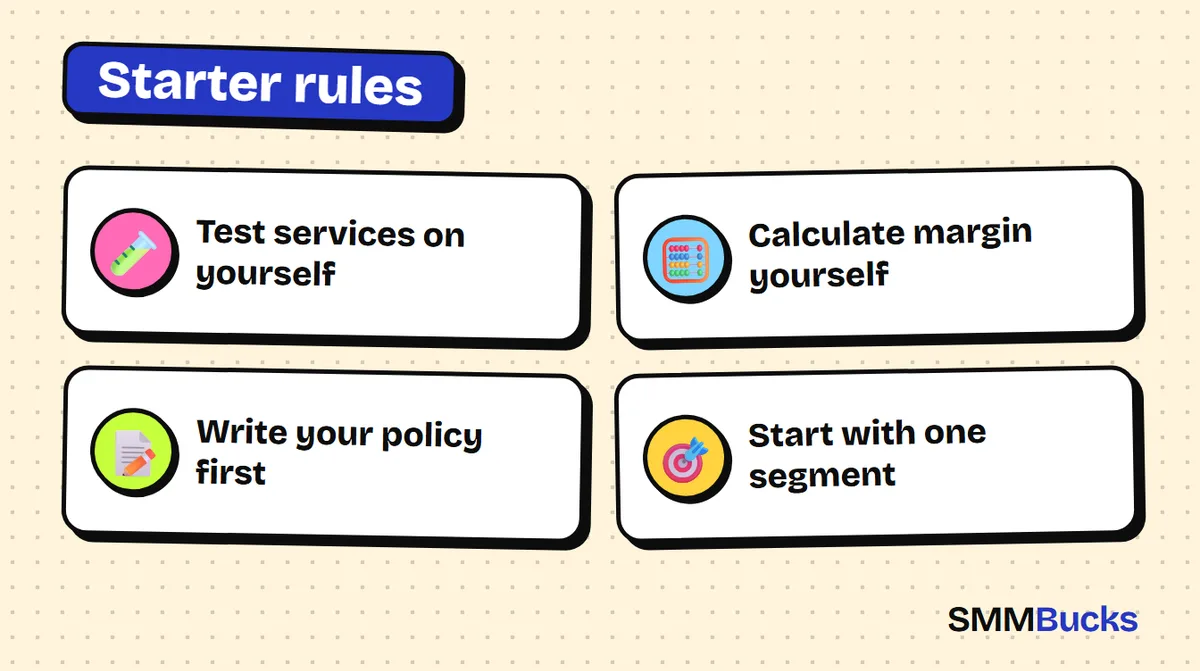
- Test services on yourself
- Calculate margin yourself
- Write your policy first
- Start with one segment
Plenty of people hear about an SMM panel business and picture a machine that prints money after one click. The reality is humbler: you are the middle layer between a customer who wants a service and a panel that delivers it, and your profit is the gap between two prices minus your time and your problems. This guide shows how to start SMM panel business operations with realistic steps: three ways to begin, a margin example, pricing, finding clients, risks and a 30-day plan. No income promises, no hype.
What is an SMM panel reseller business, really?
An SMM panel reseller business means reselling social media services: a client asks for followers, views or likes, you place the order on a panel, and you charge your own price. You need no stock or staff at the start, but you do need customer-service discipline.
You are not selling numbers, you are selling convenience. Many clients prefer to send a link to someone they trust. New to panels? Read what an SMM panel is first.
Warning: No service guarantees 100% results, and social platforms have policies on artificial engagement. Read each platform's official policy pages, decide responsibly, and explain this to your clients plainly.
What are the three ways to start your own SMM panel with SMMBucks?
Want to start own SMM panel operations? Wondering which is the best SMM panel for reseller work? Choose by budget, time and skill, and skip the biggest option at first.
Way 1: manual reselling from your own account
Open an account on SMMBucks, add a small balance and place each client's order yourself. It teaches you which services people ask for and where problems appear, at almost no cost. Begin by creating an account.
Way 2: connect through the API
With a website or Telegram bot, an SMM panel reseller API connection (see the SMMBucks API) forwards orders automatically. Try it after a few weeks of manual orders, not before. Our SMM panel API guide covers setup.
Way 3: your own child panel
A child panel (child panel SMM is a common search) gives you your own site and brand, with clients registering with you. It fits people who already have recurring clients. See the child panel page and the child panel guide. The referral program is a side path, and the earning page lists more ideas.
How does the profit margin work? A hypothetical example
The rule: profit = (selling price − cost price) × quantity ÷ 1000 − any fees. Margin as a percentage is profit divided by selling price. This is how SMM panel earnings are actually calculated.
Hypothetical example (invented numbers, for illustration only): imagine a service costs $0.50 per 1000, you sell it to your client for $1.50 per 1000, and the client orders 5,000.
- Cost: 0.50 × 5 = $2.50.
- Revenue: 1.50 × 5 = $7.50.
- Difference: $5.00.
- If we assume $0.40 in payment and transfer fees, the net is $4.60.
That profit means nothing if you spend an hour replying to one client. Your time is part of the math: the business lives on many small, well-organised orders.
Margin quietly disappears when you forget transfer fees, sell at an old price after your cost changed, or compensate a client from your own pocket. Keep a sheet with four columns (service, cost, selling price, net profit) and update it weekly.
Check current cost prices in the panel; those are the reference, not the numbers above. Loyalty levels (Bronze 2% up to Legend 12%) add automatic discounts as your total spend grows.
Which niche and client type should you pick first?
Pick one client segment and learn its language instead of selling to everyone. A narrow focus makes messages clearer and trust faster to build.
- New creators: they want an early boost and quick ordering.
- Small stores: they want their page to look active. Read our social proof guide for stores.
- Agencies and account managers: fewer, but their orders repeat and are larger. They value reliability over the lowest price.
Ask: who do I already know, and who can I talk to in their own words?
Where do you find your first clients?
Start with channels that cost you time, not money. Paid ads can wait until your routine works.
- Your own pages: post content that answers common questions, not only promotions.
- Telegram and WhatsApp groups: help store owners and creators before you pitch, and read each group's rules, because many ban promotion.
- Referrals: your first satisfied client is your best marketer. Politely ask for an introduction to a friend.
First-message template: "Hi, I help [your niche] account owners order follower and view services in an organised way. If you want the options explained, tell me your account type and I will suggest what fits." Keep it short and never oversell.
When someone replies, answer what they asked, then ask about their goal: a stronger store page, or a push for a new account? That turns you from a number seller into a small consultant. After each completed order, ask whether they were happy; it is the best moment to ask for a referral.
How should you set prices and packages?
Do not try to be the cheapest, because people who buy on price alone leave for someone cheaper. Build clear packages:
- Trial package: a small quantity for a hesitant client, to earn trust.
- Standard package: the most common order and the base of your steady income.
- Monthly package: mixed services at one fixed price.
Write down what each package includes, and whether it comes with refill (per the service description). Offer ten services you have tested yourself, not hundreds.
Two common methods: a fixed markup over cost, or a bundle price per package. The first is easier to calculate, the second easier for clients. Use the second with clients and keep the first in your sheet. Prices differ by platform, so check each platform page on SMMBucks first.
Tip: Price on current cost with a margin that absorbs price changes, and never change existing clients' prices suddenly without telling them.
What order routine protects you from problems?
Most client disputes come from skipped steps. Use the same routine for every order.
- Check the link: it must open and match the type requested (profile or post). See our guide to copying profile and post links.
- Confirm the account is public: orders start automatically after payment and need a public account at the moment of starting. No password is ever needed, only a public link or username.
- Log the order: order ID, service, quantity and time in a simple sheet.
- Watch the status: in progress, completed, partial. Update the client before they ask.
- Explain refill: some services support the Refill button in the order history, according to the service description. Warn clients a drop is possible; read our guide to drops and refill.
A partly delivered order refunds the undelivered part to your balance. Explain this in advance.
What refund policy and expectations should you write for clients?
Send a short policy before payment, not after. Adapt this version:
- The service runs on public accounts only, and the client is responsible for a correct link.
- There is no guarantee of results, of reach, or of earnings.
- The undelivered part of an order is refunded according to the order status.
- Refill applies only to services whose description says so.
- The client reads the platform's policies and decides at their own responsibility.
Honesty is not weakness: a client promised everything gets angry at the first problem. Point recurring questions to the FAQ page.
When you should not sell this service: if a client's real problem is weak content or a product nobody wants, extra numbers will not fix it. Advise them to improve the foundation first.
What are the risks, and how do you manage them?
Knowing the risks early separates a side project from a mess. The main ones:
- Platform policies: artificial engagement may break some platforms' terms, and rules change. Follow the official pages and never promise an account is safe. See is buying followers safe for the honest picture.
- Client disputes: reduce them with the written routine and a record of orders.
- Changing service quality: test a small quantity on your own account before offering a new service, and re-read descriptions.
- Margin pressure: answer competition with better service, not lower prices.
- Depending on one client: never let one client be more than a third of your orders.
Never invest money you cannot afford to lose. Any SMM panel earnings figure you see online is someone else's situation, not a promise for yours.
How to start SMM panel business in 30 days: what is the plan?
A four-week plan so you can start your own SMM panel without guessing. Adjust it to your time.
Week 1: setup
- Open an account on SMMBucks and add a small balance.
- Test 5 to 10 services on your own account.
- Write your policy and your first-message template.
Week 2: the offer
- Choose one client segment and prepare three packages.
- Create a simple page or channel with your packages.
- Message 20 people you know who fit the segment.
Week 3: first orders
- Run the first orders with the full routine and ask each client for feedback.
- Adjust packages based on the questions that repeat.
Week 4: review
- Calculate revenue, cost and the time you actually spent.
- Decide: stay manual, or move to the API or a child panel?
If results are steady, think about ordering a child panel of your own. If not, you learned cheaply, which is a gain in itself.
Frequently asked questions
Do I need a lot of capital to start an SMM panel business?
No. You can test the idea with manual orders and a small balance, filling orders when a client arrives. Set an amount you can afford to lose and test services on your own account before selling them. Once you have steady clients, you can move to the API or a child panel.
What is the difference between an API and a child panel?
The API connects your own website or bot to SMMBucks services so orders are sent automatically. A child panel is a panel of your own, with your brand and site, where your clients register directly. The API suits people with an existing system; a child panel suits those who want a ready-made platform.
How much can I earn as an SMM panel reseller?
No honest guide can give a number, because earnings depend on your cost, your selling price, your order count, your time and your service quality. Use the profit formula with your own figures, run a one-month test, and calculate what you actually made. Results may also be zero.
What should I do if followers drop after an order?
Drops can happen with some services. Check the service description to see whether it supports refill, and if so use the Refill button in the order history. Tell your client in advance, and never promise a number will stay fixed. The FAQ page has more general answers.
Does my client need to give me their password?
No. An order needs only a public link or username, and the account must be public when the order starts. If anyone asks you for a password, treat it as a warning sign, and never ask your own clients for one.
Is an SMM panel reseller business right for everyone?
No. If you cannot handle an unhappy client, or accept that platforms can change policies, it may not suit you. It needs honesty, organisation and patience, and is best not to be your only income at the start. Read the platform policies before you decide.
Ready to try your own panel?
Start with one small step, then decide. If your business proves itself, you can order a child panel of your own with SMMBucks.
Order a child panel