SMM Panel Script vs Child Panel vs API: Launch Your Own Site
An SMM panel is a website that lists follower and engagement services at your prices and passes each order to a larger provider. Most beginners start it through a ready-made child panel or an API link, then price above their true costs. Nobody can promise profit or customers, so test first and check local law and platform rules.
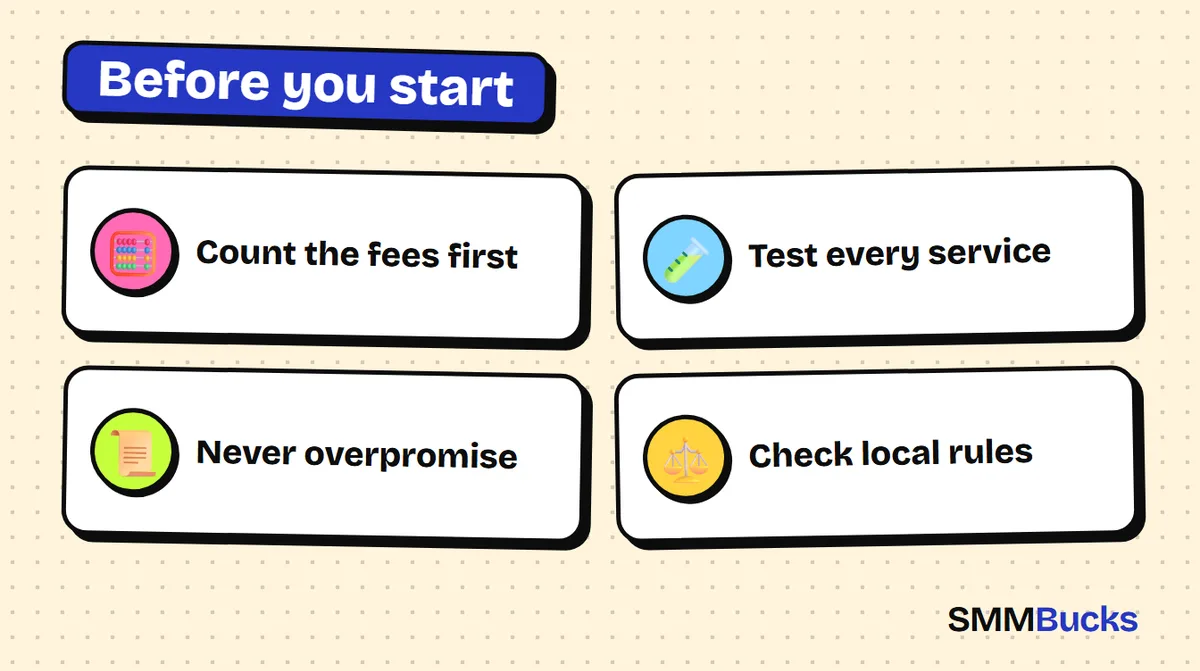
- Count the fees first
- Test every service
- Never overpromise
- Check local rules
Many people want to stop being just a customer of someone else's panel and launch their own website. The question is how: with an SMM panel script, a ready-made child panel, or an API link to your own site? The technical part is simple; the business part is hard. Building a site takes hours, earning trust takes months. This guide compares the three routes, gives a pricing example you can re-run with your own numbers, and lists the checks to make before you spend anything. No income promises, just a clear map.
What is an SMM panel business and how does it work?
An SMM panel is a website that lists services such as followers, likes and views, takes customer orders, and sends them automatically to a larger provider that fulfils them. In Arabic this is often called a "rashq server". You are the middle layer: you set prices and face the customer; the provider delivers.
- A customer signs up on your site and tops up a balance.
- They pick a service and paste the link to their public account.
- The order is forwarded to the provider automatically.
- The gap between your selling price and your cost is your margin, not your net profit.
New to the terms? Read what an SMM panel is and the glossary of drop, refill and start time first.
Warning: No service guarantees 100% results, and every platform has policies about artificial engagement. Read them before you sell to anyone.
SMM panel script, child panel or API: which route fits you?
To start own SMM panel operations and launch your own panel website, you have three routes: a ready-made child panel, an API connection to your own site or bot, or a full panel script you install and maintain. The first is fastest for a beginner; the third is the hardest and riskiest.
1) The child panel (child panel SMM)
You get a ready-made panel under your name and domain, set your own prices and keep the difference on each order. A panel subscription is required and is separate from service costs, and the child panel page says results vary from person to person. See also the child panel guide.
2) An API connection
If you already have a site or Telegram bot that takes orders, you connect it with an API key and it places orders from your balance. This is the typical SMM panel API reseller setup. It needs coding skill. Start at the API page, then the API guide for panels.
3) An SMM panel script
You buy a script, host it and secure it yourself, including updates and customer data. It is not for beginners: one vulnerability can damage your reputation before you earn anything.
How to create own SMM panel, step by step
For how to start SMM panel business on any route, first decide who you serve, then choose a route, then test every service yourself before listing it.
- Pick your audience: content creators or small shop owners. Focus on one group.
- Choose a route from the section above, based on budget and skills.
- Top up a small balance and test each service on a public account you own, watching the start and stability in the order history.
- Read every service description (country, refill, minimum) and pass those facts to customers exactly as written.
- List only 8 to 12 services instead of hundreds.
- Write a terms page saying what you do not guarantee.
- Soft-launch to a small circle and collect feedback before any advertising.
Browse the services catalog to see what you could realistically offer.
How do you price services so you don't lose money?
The right selling price is the service cost plus payment fees, plus your share of the subscription, plus your margin. Beginners usually subtract two numbers and forget the rest, so they think they profit while barely breaking even.
Hypothetical example (made-up numbers, not market benchmarks and not a promise):
- A service costs you $1.00 per 1000; you sell it at $1.60 per 1000.
- Assume payment fees take $0.08 of every $1.60 sold: $0.52 remains.
- Assume 40 orders a month at 2,000 units each, so 80,000 units. Margin: $0.52 x 80 = $41.60, before any subscription, ads or your time.
Now re-run it with your own cost, payment fees, subscription and an honest estimate of monthly orders. If the result is zero or negative, that is useful information before you invest, not a failure.
Tip: SMMBucks start-from prices are shown in USD and can change, so check the site first. For example, Instagram followers start from $0.42 per 1000 and TikTok followers from $1.02 per 1000.
Which services should your panel offer?
Choose services by testing, not by price alone. A slightly cheaper service that causes a stream of complaints costs more than any margin it earns. Look for stability and a clear description first, then cost.
- Does the description state the country or type (regular, premium or older accounts)?
- Does it say whether refill is available? Never promise what is not written.
- Have you tested it on your own public account for several days?
- Can you explain it in two honest sentences?
To judge a provider, read the guide to choosing the best SMM server. If a customer asks about safety, send them to is buying followers safe? instead of promising what you cannot control.
Is being an SMM panel reseller different from selling in bulk?
Yes. Selling in bulk means bigger orders, repeat customers and a smaller margin per unit, while small orders carry a higher margin but lower volume.
- Pricing: bulk buyers compare closely, so offer a clear quantity discount instead of haggling.
- Balance: large orders drain your provider balance faster, so plan cash flow.
- Expectations: bigger volume does not mean faster delivery or a guaranteed result.
On SMMBucks, an order that does not complete refunds the undelivered part to your balance, and levels give automatic discounts by total spend (Bronze 2% to Legend 12%). That affects your real cost, so put it in your sheet.
How do you get your first customers?
Your first customers usually come from people who already know and trust you, not from ads. Start with people who own accounts and want a small boost, and offer an honest trial order.
Tip: "Hi, I've launched a platform for social growth services and I'm looking for three people to try a small order and give honest feedback. I'll explain what the service does and doesn't do before you pay anything. Interested?"
- Explain that the account must be public when the order starts and that you never ask for a password.
- Do not post numbers or screenshots you cannot prove; credibility is your capital.
To word things accurately, read real vs fake followers.
What mistakes kill a new SMM panel in its first weeks?
Three mistakes appear again and again: pricing without counting fees, promising what you cannot guarantee, and ignoring the customer after payment. A little discipline avoids all of them.
- Pricing without the full sum: you forget fees and the subscription and work for nothing.
- Absolute promises: "100% guaranteed" or "never drops" brings complaints and may breach advertising rules.
- Ignoring the order history: "where is my order?" is usually answered by the start status there.
- No disclaimer: say that natural drops can happen and that some services support refill while others don't.
For another angle, read how to start as an SMM panel reseller.
Is running an SMM panel legal and allowed by the platforms?
There is no single answer. It depends on the law where you live and on each platform's policies. Major platforms publish rules about artificial engagement, so read the official policy pages for every platform you sell for, and ask a local legal or tax professional about registration, taxes and customer data.
- Keep your terms page and privacy policy visible.
- Collect nothing except a public link or username.
- State plainly that you do not guarantee numbers will stay or that a platform will accept them.
This guide is general information, not legal advice. The FAQ page explains orders and refunds inside SMMBucks.
When is running your own SMM panel not for you?
It does not suit you if you expect fast, guaranteed income, hate dealing with complaints, or cannot spare time to watch orders. It is a service business with real pressure, not effortless "passive income".
- Could I accept a first-year result of zero?
- Do I already have an audience or network that trusts me?
If you just want extra income from your account without running a site, the simpler route is the referral program on the affiliate page: you share your link, and you should check the current rate on the page because it can change. Either way, tell your audience when a link pays you and follow each platform's rules on affiliate links.
What is a realistic plan for your first week?
A workable first week: two days of planning and maths, two days of testing, two days of preparation and one day for a small launch. Do not pay for a subscription until your sheet shows a profit is possible.
- Day 1: write your target audience and three starter services.
- Day 2: build your pricing sheet with your own numbers.
- Days 3 and 4: register at SMMBucks, top up a small amount and test orders on your own account.
- Day 5: read the child panel guide or the API page and choose your route.
- Day 6: prepare terms and your message template.
- Day 7: send the offer to three people only.
Frequently asked questions
How do I start my own SMM panel?
Define your audience, then pick one route: a child panel, an API connection to your own site or bot, or a panel script. A child panel is easiest for beginners because it arrives ready under your name. Test every service yourself, price after fees and launch to a small circle. No profit is guaranteed.
How much does it cost to start an SMM panel?
It depends on the route. A child panel needs a separate subscription whose price this guide does not quote, so see the child panel page. On top come service balance, payment fees, a domain and possibly advertising. Add up every item before you start.
What is the difference between an SMM panel and a child panel?
SMM panel is the general name for any site that sells these services. A child panel is one way to own such a site under your name and domain, setting your own prices while a larger provider fulfils orders behind the scenes.
Do I need coding skills to build an SMM panel website?
Not necessarily. A child panel needs no coding. Connecting an API to your own site or bot needs basic technical knowledge, and a full panel script needs more experience with security and hosting. Start with the simplest route and upgrade later.
Will the numbers from an SMM panel order stay?
Nothing guarantees 100% stability. Numbers can drop after an order, for example when platforms clean up accounts. Some services support refill, depending on their description. Check the service description and order history, and never promise customers anything that is not written down.
Is it legal to run an SMM panel?
That depends on your country's laws and each platform's policies, and this guide is not legal advice. Read the official platform rules on artificial engagement, ask a local professional about registration and taxes, and be transparent about what you do not guarantee.
How much can I earn as an SMM panel reseller?
Nobody can give a reliable figure, because earnings depend on your costs, fees, order volume and ability to attract customers. Use the pricing example in this guide with your own numbers, and accept that the result may be zero at first.
Want to test before you build?
Open a SMMBucks account, look at the services and prices yourself, then decide whether a child panel suits you.
View the child panel